
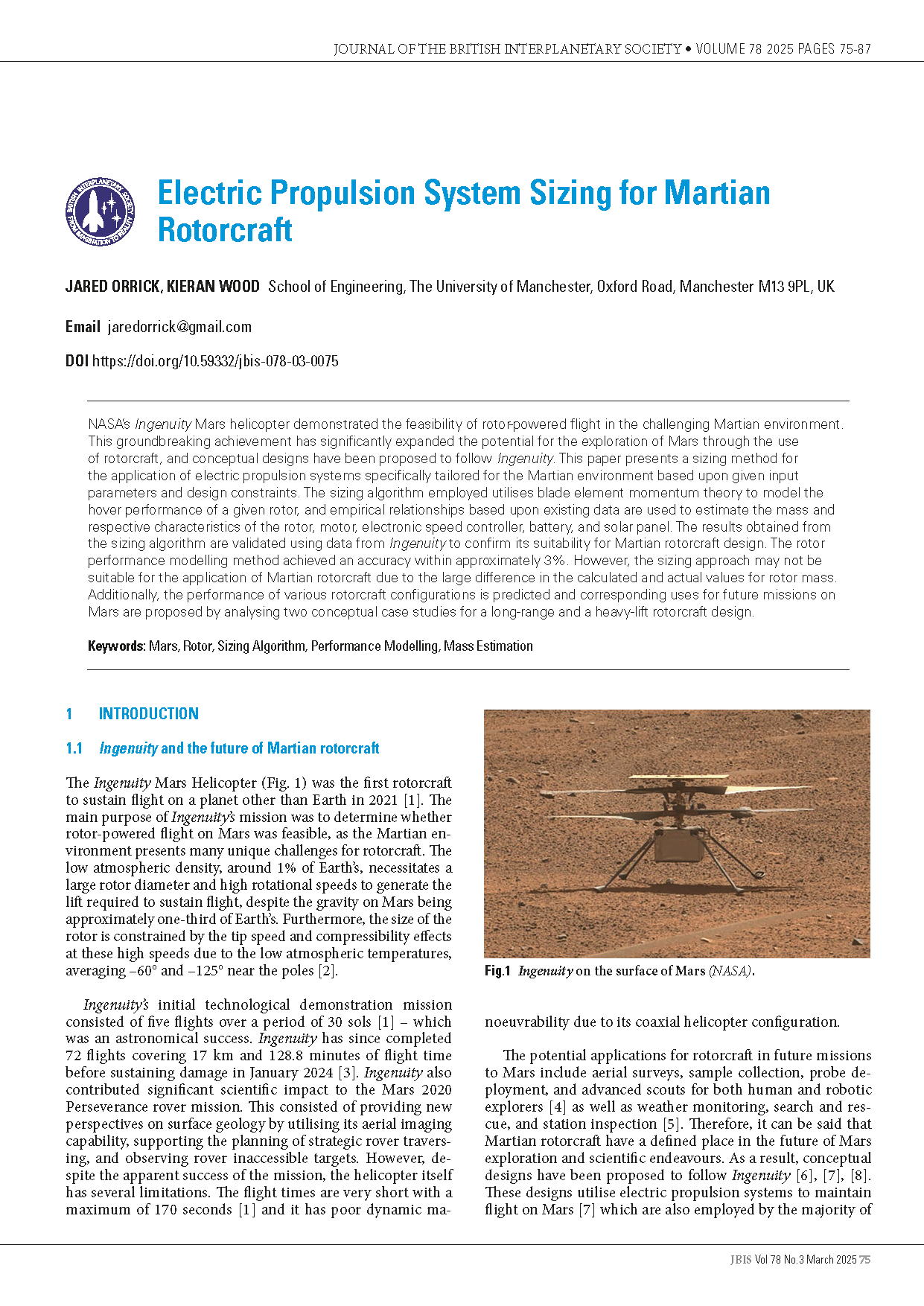
Electric Propulsion System Sizing for Martian Rotorcraft
£5.00
Jared Orrick, Kieran Wood
2025-078-0075
DOI https://doi.org/10.59332/jbis-078-03-0075
NASA’s Ingenuity Mars helicopter demonstrated the feasibility of rotor-powered flight in the challenging Martian environment. This groundbreaking achievement has significantly expanded the potential for the exploration of Mars through the use of rotorcraft, and conceptual designs have been proposed to follow Ingenuity. This paper presents a sizing method for the application of electric propulsion systems specifically tailored for the Martian environment based upon given input parameters and design constraints. The sizing algorithm employed utilises blade element momentum theory to model the hover performance of a given rotor, and empirical relationships based upon existing data are used to estimate the mass and respective characteristics of the rotor, motor, electronic speed controller, battery, and solar panel. The results obtained from the sizing algorithm are validated using data from Ingenuity to confirm its suitability for Martian rotorcraft design. The rotor performance modelling method achieved an accuracy within approximately 3%. However, the sizing approach may not be suitable for the application of Martian rotorcraft due to the large difference in the calculated and actual values for rotor mass. Additionally, the performance of various rotorcraft configurations is predicted and corresponding uses for future missions on Mars are proposed by analysing two conceptual case studies for a long-range and a heavy-lift rotorcraft design.
Keywords: Mars, Rotor, Sizing Algorithm, Performance Modelling, Mass Estimation
Related products
-
Advanced Technology for Mission Planning and Scheduling
£5.00 Add to basket -
The Nature of ETI, Its Longevity and Likely Interest in Mankind – The Human Analogy Re-Examined
£5.00 Add to basket -
SETI and the Historian – Methodological Problems in an Interdisciplinary Approach
£5.00 Add to basket -
M & C Aspects of the EGNOS Ground Segment
£5.00 Add to basket