
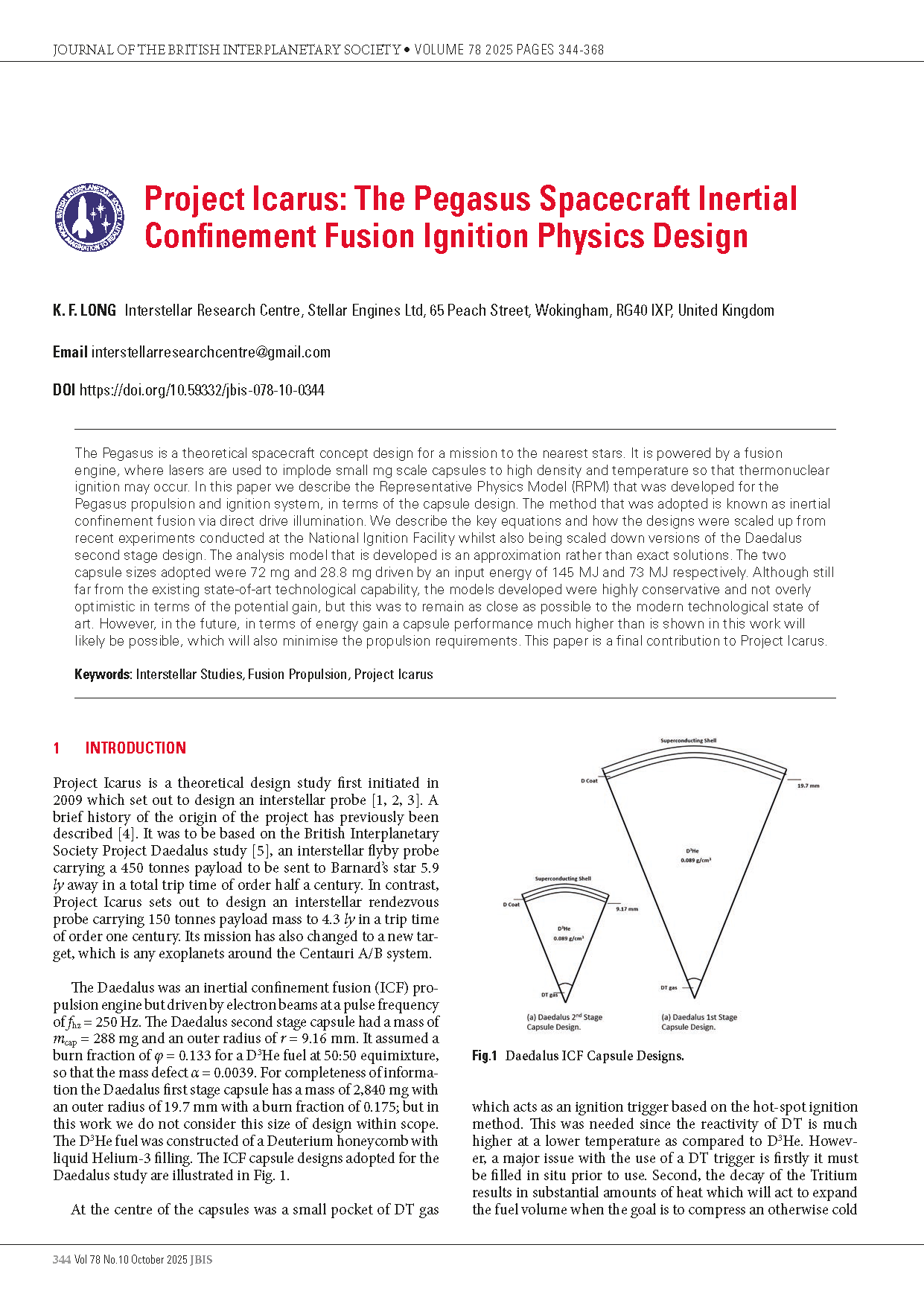
Project Icarus: The Pegasus Spacecraft Inertial Confinement Fusion Ignition Physics Design
£5.00
K. F. Long
jbis-078-10-0344
DOI https://doi.org/10.59332/jbis-078-10-0344
The Pegasus is a theoretical spacecraft concept design for a mission to the nearest stars. It is powered by a fusion engine, where lasers are used to implode small mg scale capsules to high density and temperature so that thermonuclear ignition may occur. In this paper we describe the Representative Physics Model (RPM) that was developed for the Pegasus propulsion and ignition system, in terms of the capsule design. The method that was adopted is known as inertial confinement fusion via direct drive illumination. We describe the key equations and how the designs were scaled up from recent experiments conducted at the National Ignition Facility whilst also being scaled down versions of the Daedalus second stage design. The analysis model that is developed is an approximation rather than exact solutions. The two capsule sizes adopted were 72 mg and 28.8 mg driven by an input energy of 145 MJ and 73 MJ respectively. Although still far from the existing state-of-art technological capability, the models developed were highly conservative and not overly optimistic in terms of the potential gain, but this was to remain as close as possible to the modern technological state of art. However, in the future, in terms of energy gain a capsule performance much higher than is shown in this work will likely be possible, which will also minimise the propulsion requirements. This paper is a final contribution to Project Icarus.
Keywords: Interstellar Studies, Fusion Propulsion, Project Icarus
Related products
-
A Global Multidisciplinary Approach to ETI Research – A Cyclic Nonperiodic Natural Code
£5.00 Add to basket -
M & C Aspects of the EGNOS Ground Segment
£5.00 Add to basket -
The Tough Road Travelled – A New Look at the Second Generation Luna Probes
£5.00 Add to basket -
Advanced Technology for Mission Planning and Scheduling
£5.00 Add to basket