
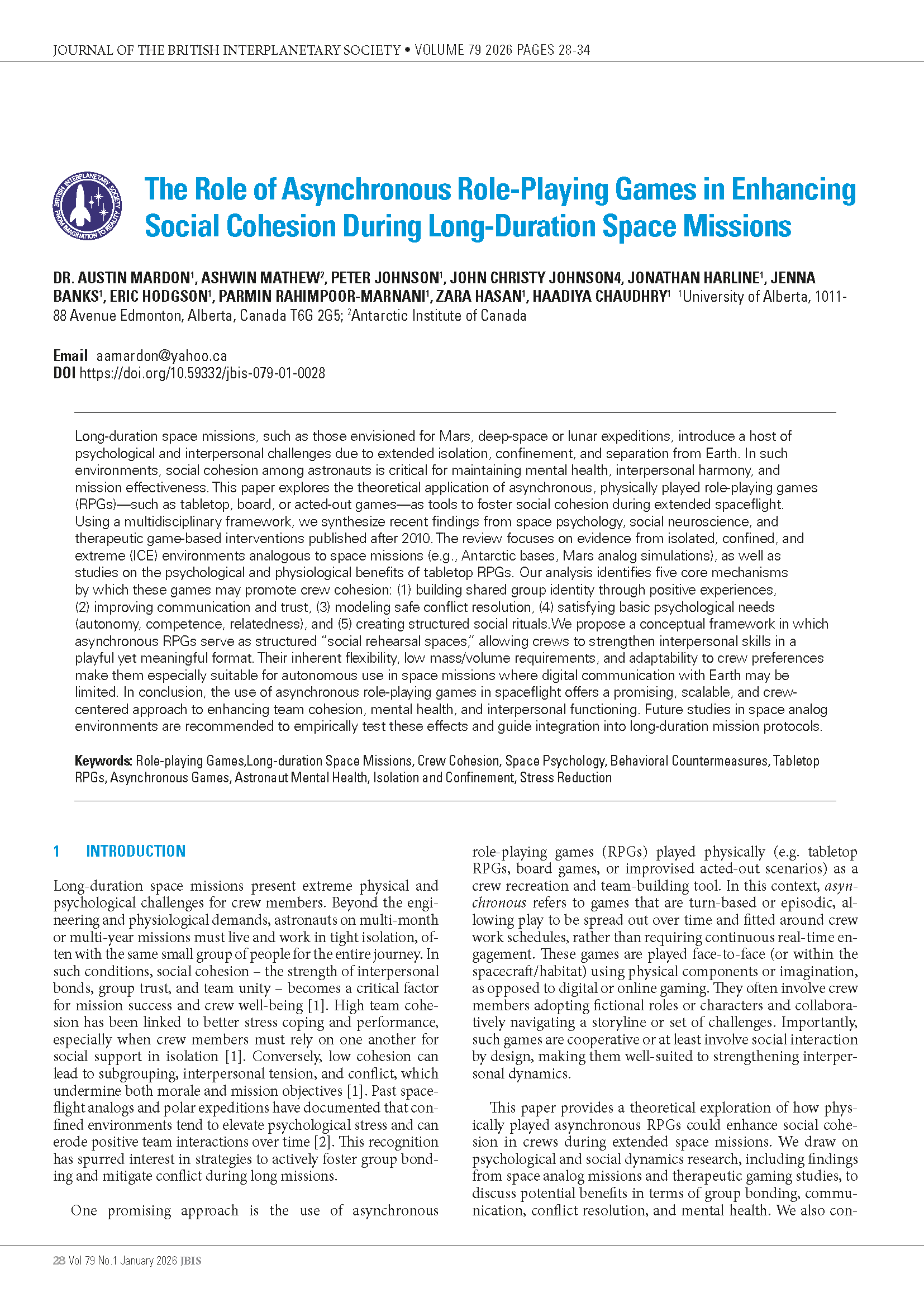
The Role of Asynchronous Role-Playing Games in Enhancing Social Cohesion During Long-Duration Space Missions
£5.00
Austin Mardon, Ashwin Mathew (Antarctic Institute of Canada), Peter Johnson, John Christy Johnson, Jonathan Harline, Jenna Banks, Eric Hodgson, Parmin Rahimpoor-Marnani, Zara Hasan, Haadiya Chaudhry
2026.079.0028
DOI https://doi.org/10.59332/jbis-079-01-0028
Long-duration space missions, such as those envisioned for Mars, deep-space or lunar expeditions, introduce a host of psychological and interpersonal challenges due to extended isolation, confinement, and separation from Earth. In such environments, social cohesion among astronauts is critical for maintaining mental health, interpersonal harmony, and mission effectiveness. This paper explores the theoretical application of asynchronous, physically played role-playing games (RPGs)äóîsuch as tabletop, board, or acted-out gamesäóîas tools to foster social cohesion during extended spaceflight. Using a multidisciplinary framework, we synthesize recent findings from space psychology, social neuroscience, and therapeutic game-based interventions published after 2010. The review focuses on evidence from isolated, confined, and extreme (ICE) environments analogous to space missions (e.g., Antarctic bases, Mars analog simulations), as well as studies on the psychological and physiological benefits of tabletop RPGs. Our analysis identifies five core mechanisms by which these games may promote crew cohesion: (1) building shared group identity through positive experiences, (2) improving communication and trust, (3) modeling safe conflict resolution, (4) satisfying basic psychological needs (autonomy, competence, relatedness), and (5) creating structured social rituals.We propose a conceptual framework in which asynchronous RPGs serve as structured äóìsocial rehearsal spaces,äó allowing crews to strengthen interpersonal skills in a playful yet meaningful format. Their inherent flexibility, low mass/volume requirements, and adaptability to crew preferences make them especially suitable for autonomous use in space missions where digital communication with Earth may be limited. In conclusion, the use of asynchronous role-playing games in spaceflight offers a promising, scalable, and crew-centered approach to enhancing team cohesion, mental health, and interpersonal functioning. Future studies in space analog environments are recommended to empirically test these effects and guide integration into long-duration mission protocols.
Keywords: Role-playing Games,Long-duration Space Missions, Crew Cohesion, Space Psychology, Behavioral Countermeasures, Tabletop RPGs, Asynchronous Games, Astronaut Mental Health, Isolation and Confinement, Stress Reduction
Related products
-
On Pressures in the Liquid Propellant Rocket Engine Part II: An Experimental Review
£0.00 Add to basket -
Laser-ZPE Interstellar Propulsion Revisited
£5.00 Add to basket -
Ultra-Long Wave Civilization Filter: a Selective Approach to Interstellar Communication
£5.00 Add to basket -
Kinematic and Spectroscopic Constraints on the Origin of Interstellar Object 3I/ATLAS: An Ablative Propulsion Model
£5.00 Add to basket