
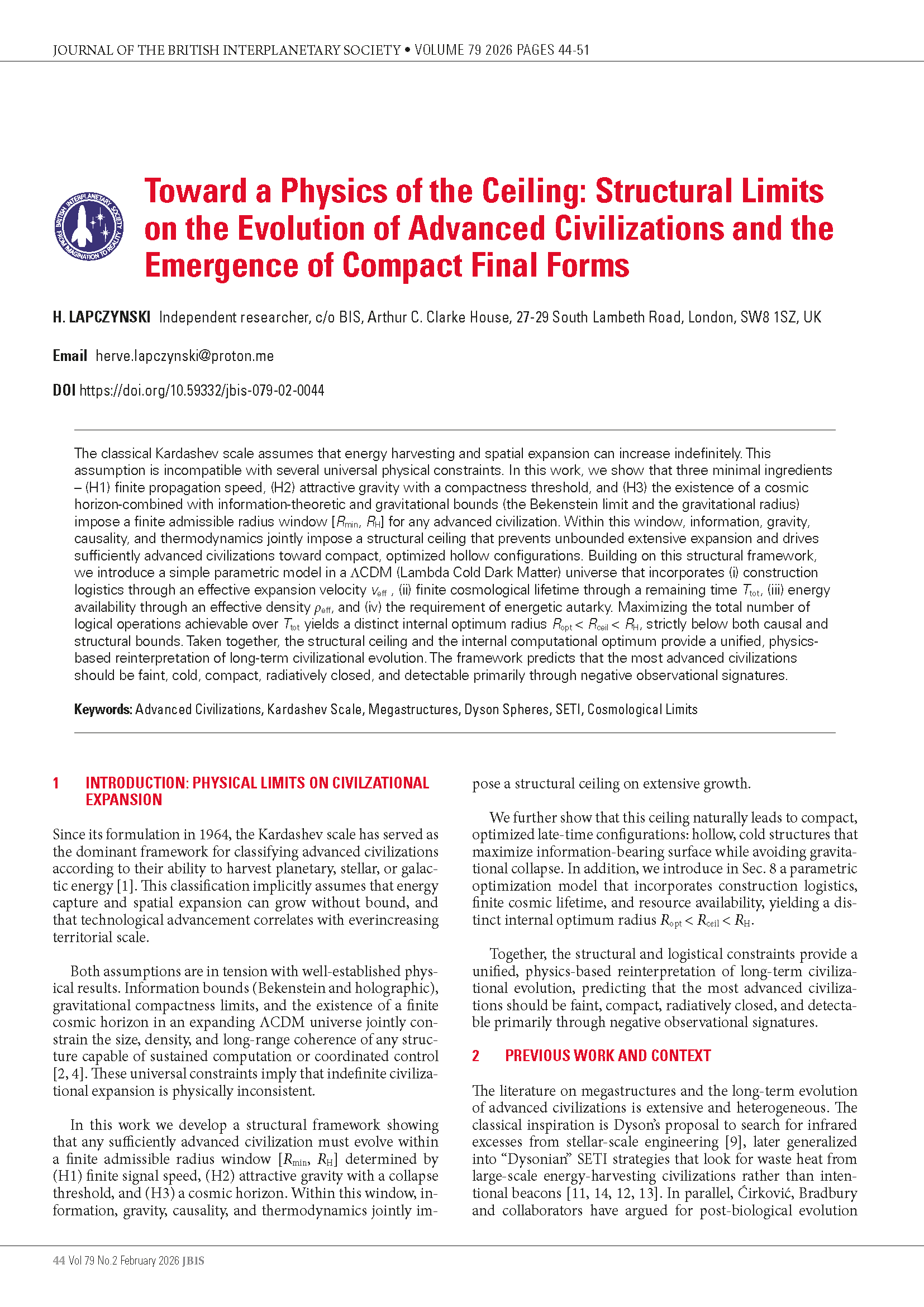
Toward a Physics of the Ceiling: Structural Limits on the Evolution of Advanced Civilizations and the Emergence of Compact Final Forms
£5.00
H. Lapczynski
2026.079.0044
DOI https://doi.org/10.59332/jbis-079-02-0044
The classical Kardashev scale assumes that energy harvesting and spatial expansion can increase indefinitely. This assumption is incompatible with several universal physical constraints. In this work, we show that three minimal ingredients äóñ (H1) finite propagation speed, (H2) attractive gravity with a compactness threshold, and (H3) the existence of a cosmic horizon-combined with information-theoretic and gravitational bounds (the Bekenstein limit and the gravitational radius) impose a finite admissible radius window [Rmin, RH] for any advanced civilization. Within this window, information, gravity, causality, and thermodynamics jointly impose a structural ceiling that prevents unbounded extensive expansion and drives sufficiently advanced civilizations toward compact, optimized hollow configurations. Building on this structural framework, we introduce a simple parametric model in a ‘_CDM (Lambda Cold Dark Matter) universe that incorporates (i) construction logistics through an effective expansion velocity veff , (ii) finite cosmological lifetime through a remaining time Ttot, (iii) energy availability through an effective density “eff, and (iv) the requirement of energetic autarky. Maximizing the total number of logical operations achievable over Ttot yields a distinct internal optimum radius Ropt < Rceil < RH, strictly below both causal and structural bounds. Taken together, the structural ceiling and the internal computational optimum provide a unified, physics-based reinterpretation of long-term civilizational evolution. The framework predicts that the most advanced civilizations should be faint, cold, compact, radiatively closed, and detectable primarily through negative observational signatures.
Keywords: Advanced Civilizations, Kardashev Scale, Megastructures, Dyson Spheres, SETI, Cosmological Limits
Related products
-
“Space Privateers”: A Strategic Framework for Commercial Integration in Space Defence
£5.00 Add to basket -
We the Living: There is absolutely nothing wrong with the species-level perspective on space settlement
£5.00 Add to basket -
In Consideration of Artificial Nanoprobes Jet Ejection from the Interstellar Object 3I/ATLAS
£0.00 Add to basket -
Laser-ZPE Interstellar Propulsion Revisited
£5.00 Add to basket