
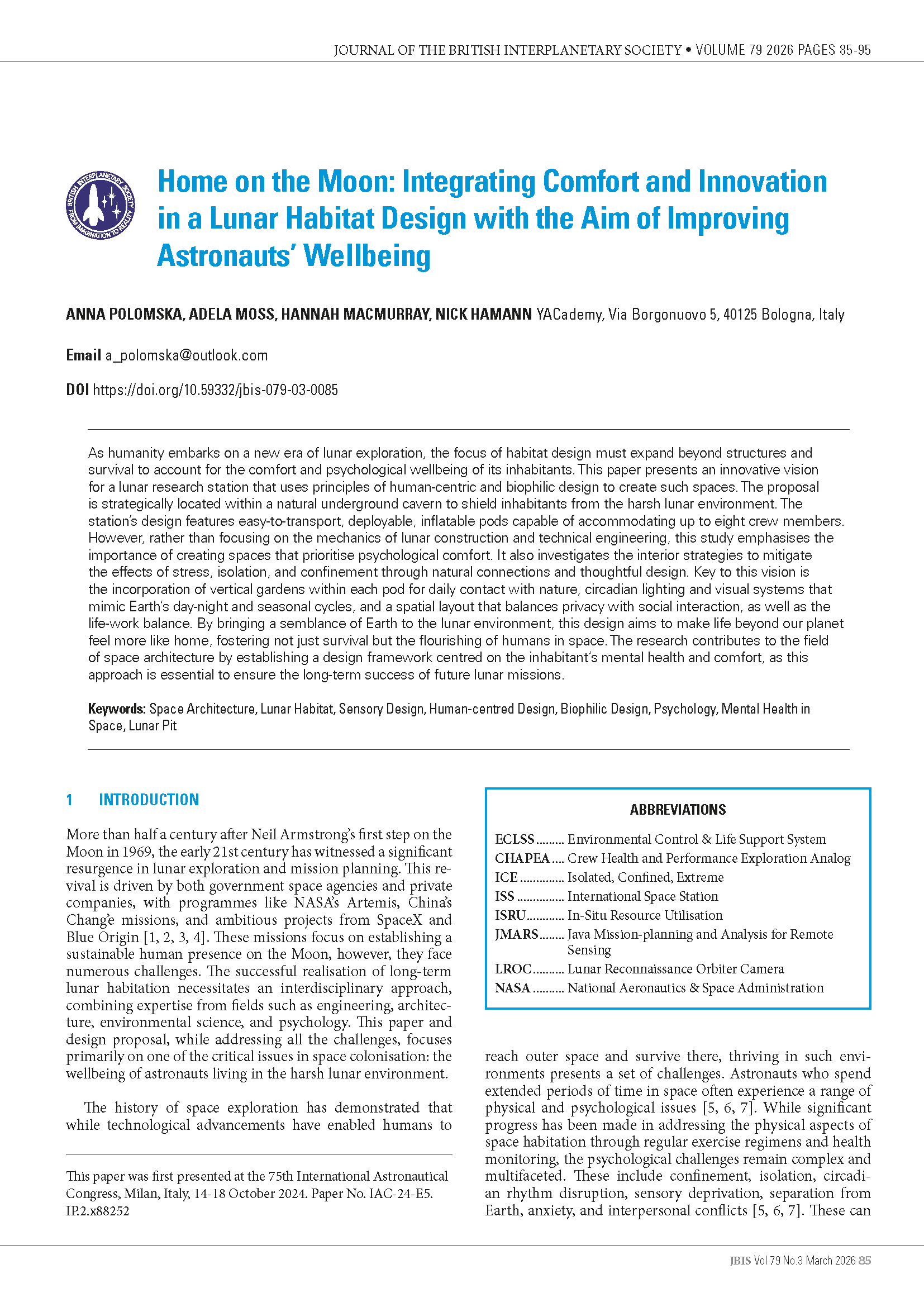
Home on the Moon: Integrating Comfort and Innovation in a Lunar Habitat Design with the Aim of Improving Astronauts’ Wellbeing
£5.00
Anna PolomskaAdela Moss, Hannah MacMurray, Nick Hamann
2026.079.0085
DOI https://doi.org/10.59332/jbis-079-03-0085
As humanity embarks on a new era of lunar exploration, the focus of habitat design must expand beyond structures and survival to account for the comfort and psychological wellbeing of its inhabitants. This paper presents an innovative vision for a lunar research station that uses principles of human-centric and biophilic design to create such spaces. The proposal is strategically located within a natural underground cavern to shield inhabitants from the harsh lunar environment. The station’s design features easy-to-transport, deployable, inflatable pods capable of accommodating up to eight crew members. However, rather than focusing on the mechanics of lunar construction and technical engineering, this study emphasises the importance of creating spaces that prioritise psychological comfort. It also investigates the interior strategies to mitigate the effects of stress, isolation, and confinement through natural connections and thoughtful design. Key to this vision is the incorporation of vertical gardens within each pod for daily contact with nature, circadian lighting and visual systems that mimic Earth’s day-night and seasonal cycles, and a spatial layout that balances privacy with social interaction, as well as the life-work balance. By bringing a semblance of Earth to the lunar environment, this design aims to make life beyond our planet feel more like home, fostering not just survival but the flourishing of humans in space. The research contributes to the field of space architecture by establishing a design framework centred on the inhabitant’s mental health and comfort, as this approach is essential to ensure the long-term success of future lunar missions.
Keywords: Space Architecture, Lunar Habitat, Sensory Design, Human-centred Design, Biophilic Design, Psychology, Mental Health in Space, Lunar Pit
Related products
-
Post-gravity Design: Approaches to Orientation in Design for Spaceflight
£0.00 Add to basket -
Kinematic and Spectroscopic Constraints on the Origin of Interstellar Object 3I/ATLAS: An Ablative Propulsion Model
£5.00 Add to basket -
On Pressures in the Liquid Propellant Rocket Engine Part II: An Experimental Review
£0.00 Add to basket -
Balanced Architecture: Optimizing Human Habitability and Spin Stability in an Artificial Gravity Space Station
£5.00 Add to basket