
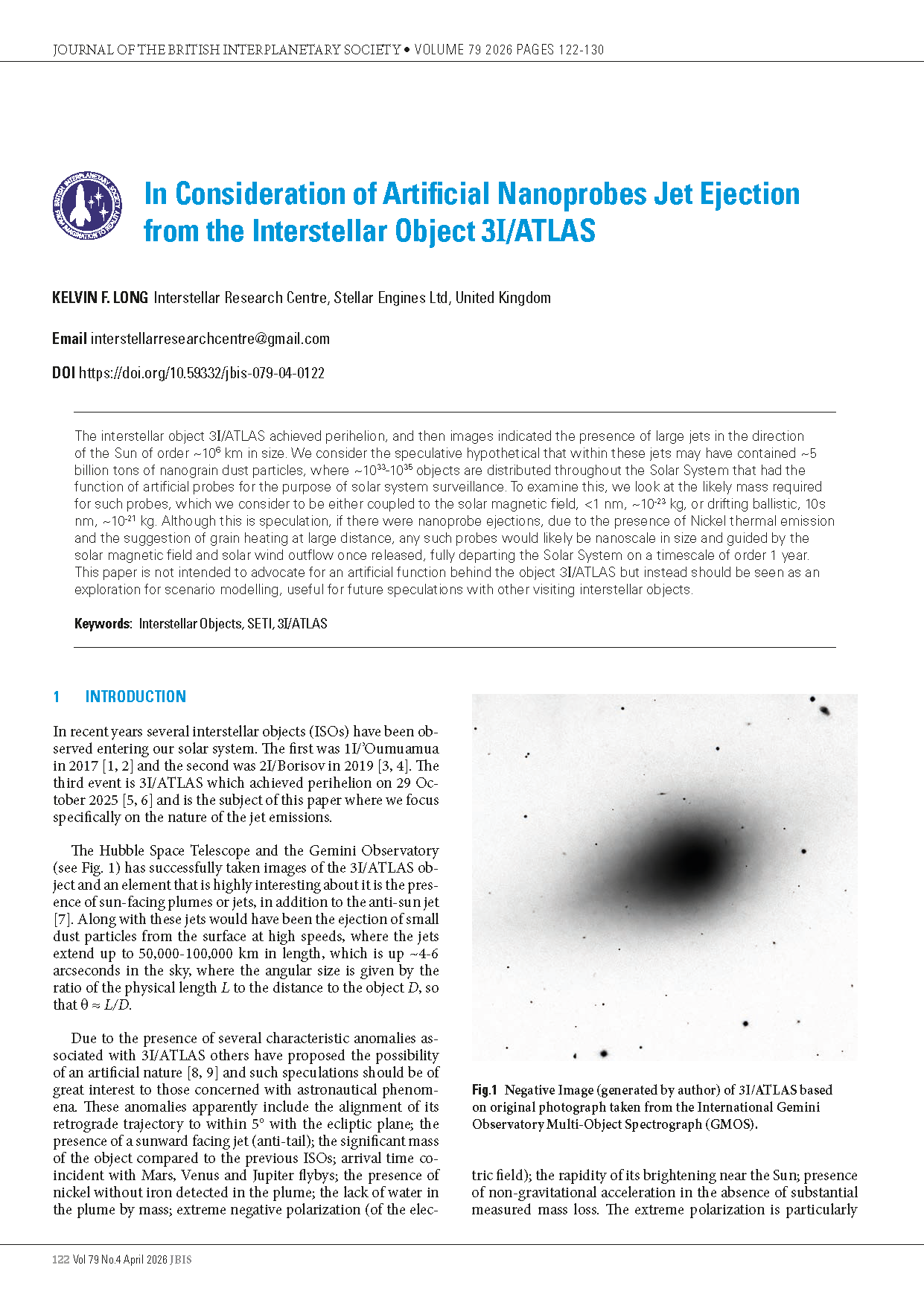
In Consideration of Artificial Nanoprobes Jet Ejection from the Interstellar Object 3I/ATLAS
£0.00
KELVIN F. LONG
2026.079.0122
DOI https://doi.org/10.59332/jbis-079-04-0122
The interstellar object 3I/ATLAS achieved perihelion, and then images indicated the presence of large jets in the direction of the Sun of order ~106 km in size. We consider the speculative hypothetical that within these jets may have contained ~5 billion tons of nanograin dust particles, where ~1033-1035 objects are distributed throughout the Solar System that had the function of artificial probes for the purpose of solar system surveillance. To examine this, we look at the likely mass required for such probes, which we consider to be either coupled to the solar magnetic field, <1 nm, ~10-23 kg, or drifting ballistic, 10s nm, ~10-21 kg. Although this is speculation, if there were nanoprobe ejections, due to the presence of Nickel thermal emission and the suggestion of grain heating at large distance, any such probes would likely be nanoscale in size and guided by the solar magnetic field and solar wind outflow once released, fully departing the Solar System on a timescale of order 1 year. This paper is not intended to advocate for an artificial function behind the object 3I/ATLAS but instead should be seen as an exploration for scenario modelling, useful for future speculations with other visiting interstellar objects..
Keywords: Keywords: Interstellar Objects, SETI, 3I/ATLAS
Related products
-
Balanced Architecture: Optimizing Human Habitability and Spin Stability in an Artificial Gravity Space Station
£5.00 Add to basket -
Post-gravity Design: Approaches to Orientation in Design for Spaceflight
£0.00 Add to basket -
On Pressures in the Liquid Propellant Rocket Engine Part I: An Alternative Calculation Method
£0.00 Add to basket -

Ultra-Long Wave Civilization Filter: a Selective Approach to Interstellar Communication
£5.00 Add to basket