
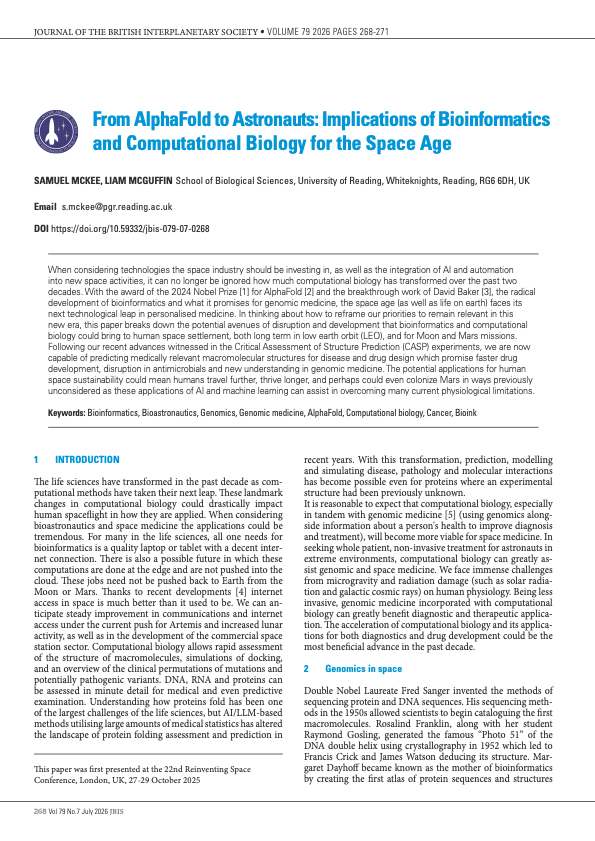
From AlphaFold to Astronauts: Implications of Bioinformatics and Computational Biology for the Space Age
£5.00
SAMUEL MCKEE, LIAM MCGUFFIN
2026.79.0268
DOI https://doi.org/10.59332/jbis-079-07-0268
When considering technologies the space industry should be investing in, as well as the integration of AI and automation into new space activities, it can no longer be ignored how much computational biology has transformed over the past two decades. With the award of the 2024 Nobel Prize [1] for AlphaFold [2] and the breakthrough work of David Baker [3], the radical development of bioinformatics and what it promises for genomic medicine, the space age (as well as life on earth) faces its next technological leap in personalised medicine. In thinking about how to reframe our priorities to remain relevant in this new era, this paper breaks down the potential avenues of disruption and development that bioinformatics and computational biology could bring to human space settlement, both long term in low earth orbit (LEO), and for Moon and Mars missions. Following our recent advances witnessed in the Critical Assessment of Structure Prediction (CASP) experiments, we are now capable of predicting medically relevant macromolecular structures for disease and drug design which promise faster drug development, disruption in antimicrobials and new understanding in genomic medicine. The potential applications for human space sustainability could mean humans travel further, thrive longer, and perhaps could even colonize Mars in ways previously unconsidered as these applications of AI and machine learning can assist in overcoming many current physiological limitations.
Keywords: Bioinformatics, Bioastronautics, Genomics, Genomic medicine, AlphaFold, Computational biology, Cancer, Bioink
Related products
-
The Prospects for Microwave Actuated Airbreathing Hypersonic Spaceplane Engines
£5.00 Add to basket -
Validating Neuromorphic Autonomy for Deep-Space Operations
£0.00 Add to basket -
Post-gravity Design: Approaches to Orientation in Design for Spaceflight
£0.00 Add to basket -
Home on the Moon: Integrating Comfort and Innovation in a Lunar Habitat Design with the Aim of Improving Astronauts’ Wellbeing
£5.00 Add to basket