
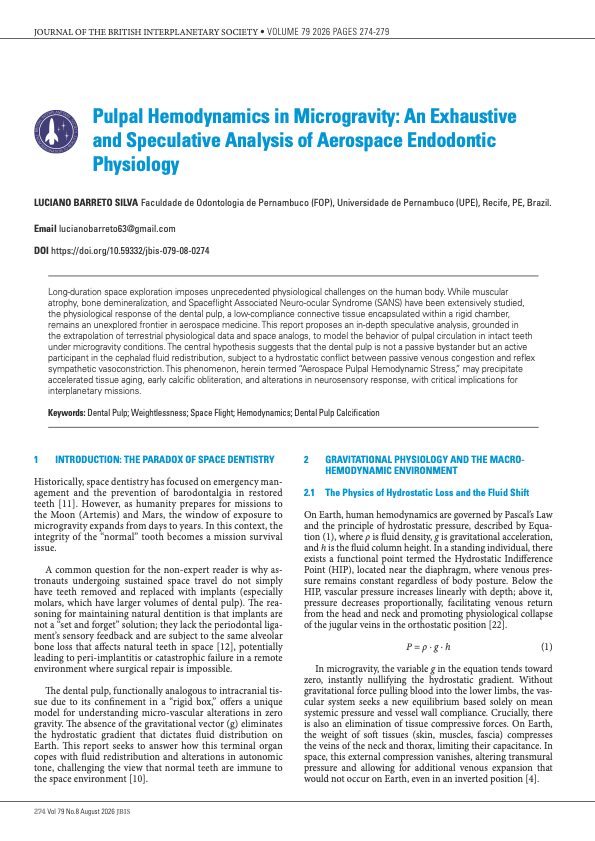
Pulpal Hemodynamics in Microgravity: An Exhaustive and Speculative Analysis of Aerospace Endodontic Physiology
£5.00
LUCIANO BARRETO SILVA
2026.79.0274
DOI https://doi.org/10.59332/jbis-079-08-0274
Long-duration space exploration imposes unprecedented physiological challenges on the human body. While muscular atrophy, bone demineralization, and Spaceflight Associated Neuro-ocular Syndrome (SANS) have been extensively studied, the physiological response of the dental pulp, a low-compliance connective tissue encapsulated within a rigid chamber, remains an unexplored frontier in aerospace medicine. This report proposes an in-depth speculative analysis, grounded in the extrapolation of terrestrial physiological data and space analogs, to model the behavior of pulpal circulation in intact teeth under microgravity conditions. The central hypothesis suggests that the dental pulp is not a passive bystander but an active participant in the cephalad fluid redistribution, subject to a hydrostatic conflict between passive venous congestion and reflex sympathetic vasoconstriction. This phenomenon, herein termed “Aerospace Pulpal Hemodynamic Stress,” may precipitate accelerated tissue aging, early calcific obliteration, and alterations in neurosensory response, with critical implications for interplanetary missions.
Keywords: Dental Pulp; Weightlessness; Space Flight; Hemodynamics; Dental Pulp Calcification
Related products
-
Balanced Architecture: Optimizing Human Habitability and Spin Stability in an Artificial Gravity Space Station
£5.00 Add to basket -
Toward a Physics of the Ceiling: Structural Limits on the Evolution of Advanced Civilizations and the Emergence of Compact Final Forms
£5.00 Add to basket -
Geopolitics and International Space Exploration Plans For the Near Future
£5.00 Add to basket -
Ultra-Long Wave Civilization Filter: a Selective Approach to Interstellar Communication
£5.00 Add to basket