
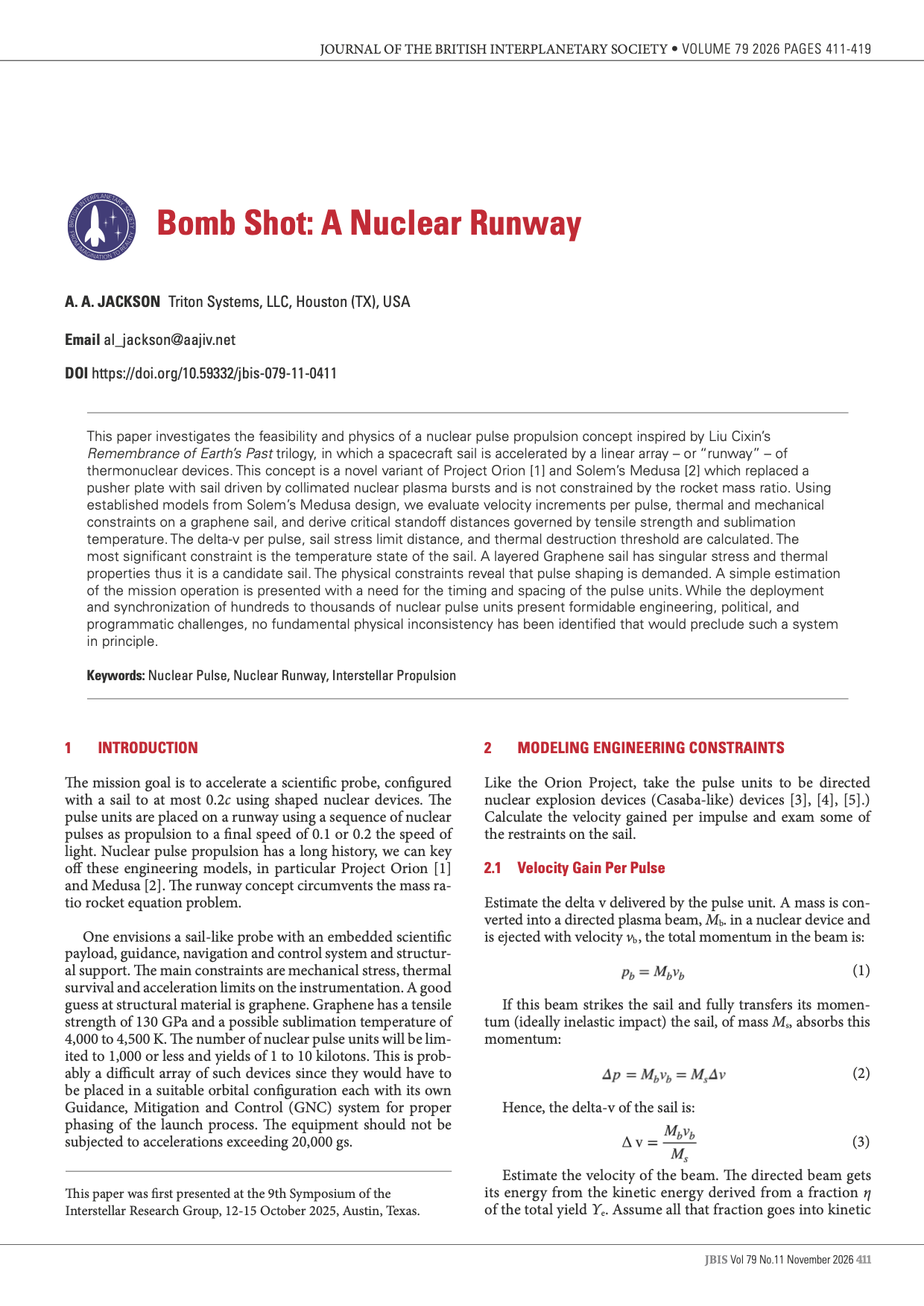
Bomb Shot: A Nuclear Runway
£5.00
A. A. JACKSON
2026.79.0411
DOI https://doi.org/10.59332/jbis-079-10-0411
This paper investigates the feasibility and physics of a nuclear pulse propulsion concept inspired by Liu Cixin’s Remembrance of Earth’s Past trilogy, in which a spacecraft sail is accelerated by a linear array – or “runway” – of thermonuclear devices. This concept is a novel variant of Project Orion [1] and Solem’s Medusa [2] which replaced a pusher plate with sail driven by collimated nuclear plasma bursts and is not constrained by the rocket mass ratio. Using established models from Solem’s Medusa design, we evaluate velocity increments per pulse, thermal and mechanical constraints on a graphene sail, and derive critical standoff distances governed by tensile strength and sublimation temperature. The delta-v per pulse, sail stress limit distance, and thermal destruction threshold are calculated. The most significant constraint is the temperature state of the sail. A layered Graphene sail has singular stress and thermal properties thus it is a candidate sail. The physical constraints reveal that pulse shaping is demanded. A simple estimation of the mission operation is presented with a need for the timing and spacing of the pulse units. While the deployment and synchronization of hundreds to thousands of nuclear pulse units present formidable engineering, political, and programmatic challenges, no fundamental physical inconsistency has been identified that would preclude such a system in principle.
Keywords: Nuclear Pulse, Nuclear Runway, Interstellar Propulsion
Related products
-
The Role of Asynchronous Role-Playing Games in Enhancing Social Cohesion During Long-Duration Space Missions
£5.00 Add to basket -
In Consideration of Artificial Nanoprobes Jet Ejection from the Interstellar Object 3I/ATLAS
£0.00 Add to basket -
Home on the Moon: Integrating Comfort and Innovation in a Lunar Habitat Design with the Aim of Improving Astronauts’ Wellbeing
£5.00 Add to basket -
Kinematic and Spectroscopic Constraints on the Origin of Interstellar Object 3I/ATLAS: An Ablative Propulsion Model
£5.00 Add to basket