Description
Reaching another star is one challenge. Slowing down when we arrive is another.
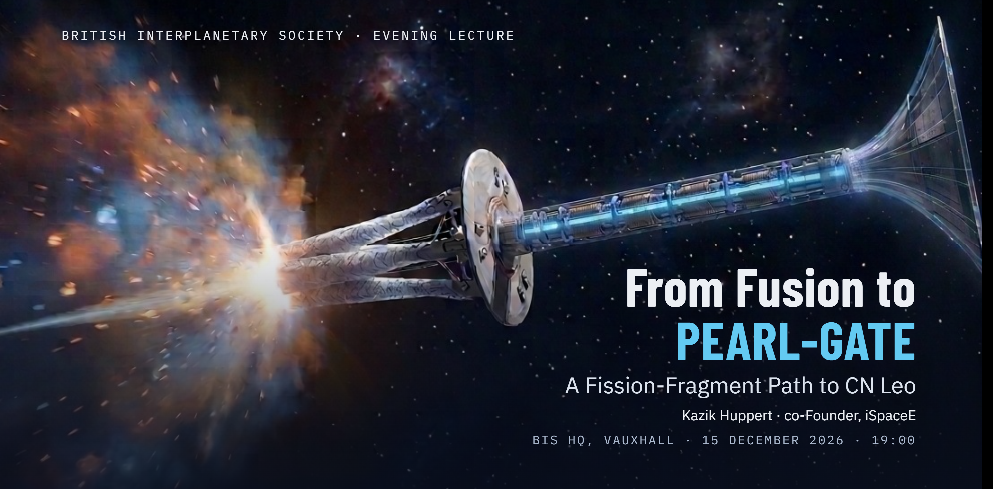
For this BIS evening lecture, Kazik Huppert joins us live by video link to introduce PEARL-GATE, a proposed fission-fragment propulsion concept being developed through iSpaceE. Its ambition is to explore a journey to CN Leonis, also known as Wolf 359, with a spacecraft that could rendezvous with its destination rather than simply race past.
Following in the tradition of the British Interplanetary Society’s Project Daedalus and Project Icarus studies, PEARL-GATE explores a different route to interstellar propulsion: using the energetic products of nuclear fission directly to generate thrust.
At the heart of PEARL-GATE is a proposed open-cycle, accelerator-driven subcritical fission system. Rather than treating electricity generation as the first step in a propulsion chain, the concept seeks to use the fission fragments themselves as exhaust, with electrical power generated as a byproduct.
Kazik will introduce the thinking behind the architecture and explore the calculations underpinning its proposed performance. Could such a system make a rendezvous mission to another star achievable within a century? What would that demand in fuel, spacecraft mass and engineering capability—and which assumptions still need to be tested?
The lecture will also introduce the project’s developing digital model and consider the work needed to move from an initial concept towards a more detailed engineering design.
Interstellar mission studies bring together ambitious destinations and demanding questions. Propulsion, power, spacecraft mass. and the need to decelerate must all work together within a credible mission architecture.
About the Event
This evening offers an opportunity to hear about PEARL-GATE as a work in progress, question its assumptions, and discuss the physics and engineering challenges that would need to be addressed.
Kazik’s presentation will be online via Zoom. The presentation will be followed by questions and discussion, and joining us at HQ in person will be Kazik’s iSpaceE partners, Dr Peter Shaw from Kingston University, Cristian DobranszkiLead ScientistFirst Light Fusion and Edmund Simons from Surrey Satellite Technology Ltd.
Join us in person at Arthur C. Clarke House or online to hear about this remarkable project.
About the Speaker
Kazik Huppert is the originator of the PEARL-GATE propulsion concept and a co-founder of iSpaceE, where he works as Project Development Head.
Based in Belfast, he came to propulsion research through an unconventional route, following decades of teaching English for Specific Purposes to astronomy and engineering students. His current work focuses on developing PEARL-GATE’s digital concept model and exploring how it might progress towards a more detailed engineering study.